
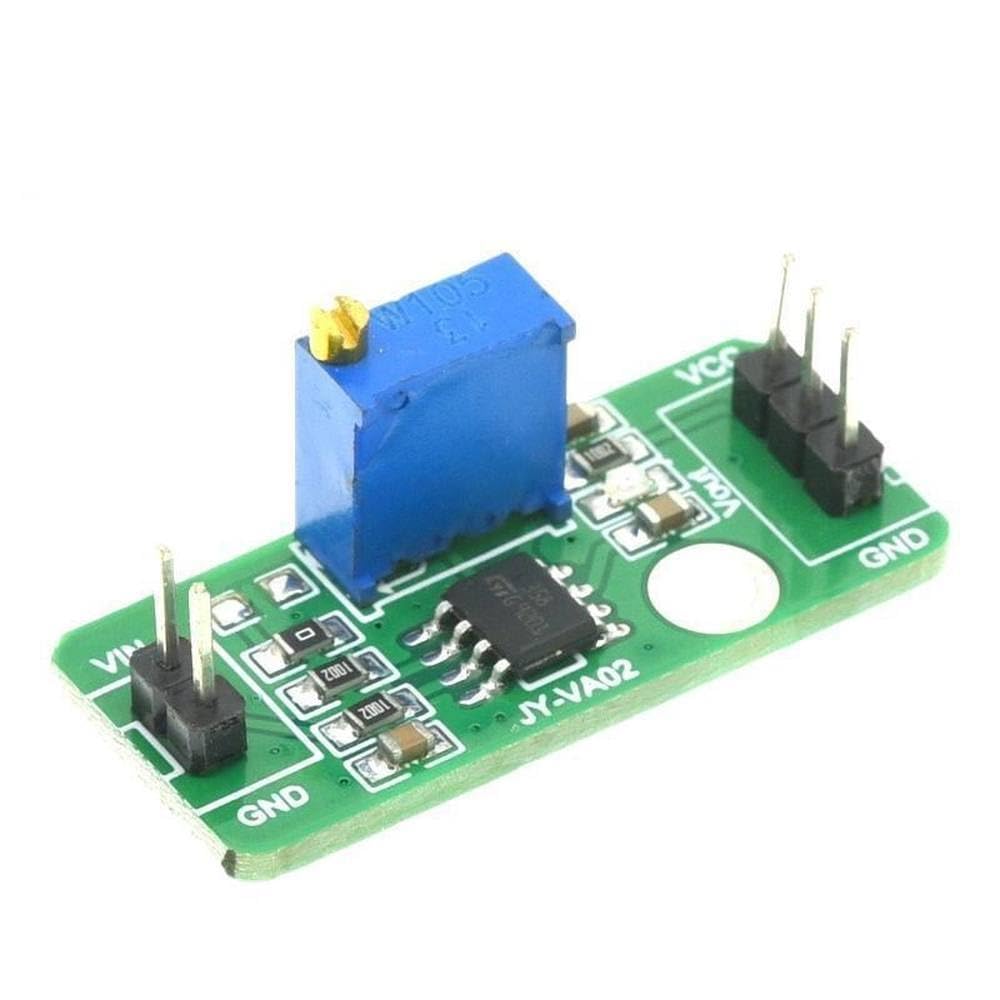
The LM393 Voltage Comparator Module is a widely used electronic component designed to compare two input voltage levels and provide a digital output based on which one is higher. It is primarily used for digitizing analog sensor signals, such as those from light (LDR) or temperature (NTC) sensors, into simple HIGH or LOW logic levels.
Key Specifications:
Operating Voltage: Typically ranges from 3.3V to 5V for standard modules, though some high-voltage variants support up to 28V or 30V.
Output Type: Digital Output (DO) and often an Analog Output (AO).
Threshold Adjustment: Features an onboard potentiometer to set the reference voltage for switching.
Indicator LEDs: Includes a Power LED and a Status LED that lights up when the digital output reaches a specific state (usually LOW).
Response Time: Fast switching, making it suitable for signal wave generation and basic automation.
Pin Configuration:
Most common 4-pin modules include the following connections:
VCC: Positive power supply (typically 3.3V – 5V).
GND: Ground connection.
DO (Digital Output): High/Low signal based on the comparison.
AO (Analog Output): Direct signal from the connected sensor before comparison.
Typical Applications:
The module is a staple in DIY and robotics projects due to its compatibility with Arduino and Raspberry Pi.
Light Detection: Pairing with an LDR to create automatic night lights or solar trackers.
Temperature Control: Using a thermistor to trigger cooling fans or heaters at specific thresholds.
Soil Moisture Sensing: Detecting when plants need water by converting soil resistance into a digital trigger.
Battery Monitoring: Triggering alarms when voltage drops below a certain level.
Usage Tips:
Potentiometer Calibration: Rotate the onboard screw to fine-tune the exact point at which the digital signal switches.
Direct Driving: While the output can sometimes drive low-power loads like LEDs directly, it is best to use a relay module or transistor for larger components like motors.
Unused Pins: In modules using only one channel of the dual LM393 chip, the other channel is typically tied to ground to prevent noise.