
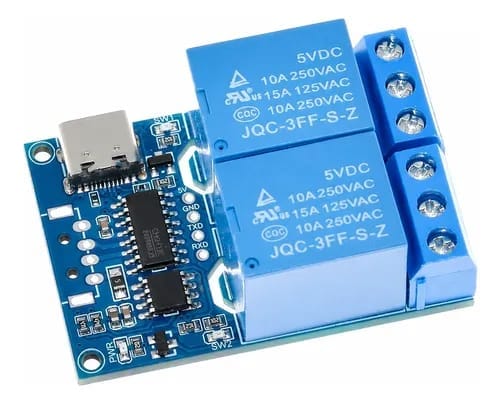
2-Channel Relay (Type-C) – 5V/10A

 8,000

3 in stock

3 in stock

Fast Shipping

Technical Support

Nationwide Delivery

To all 36 States

Description

The 2-Channel Relay (Type-C) – 5V/10A module is equipped with a stable USB to serial chip and microcontroller, which can be used on the computer to send serial commands through serial debugging software to control the opening and closing of relays.

Key Features:

  • Number of Channels: 2
  • Relay Type: Typically Single-Pole Double-Throw (SPDT) or Single-Pole Single-Throw (SPST)
  • Control Signal: Low voltage control signals (e.g., from microcontrollers or digital circuits)
  • Isolation: Provides electrical isolation between the control circuit and the high voltage circuit
  • Status Indication: Often includes LEDs to indicate relay status
  • Hardware: Features a USB-to-serial converter and an onboard microcontroller.
  • Control Method: Receives serial commands from a computer via debugging software.
  • Function: Operates the opening and closing states of attached electrical relays.

Technical Specifications:

  • Control Voltage: 5V DC (commonly used with microcontrollers like Arduino)
  • Relay Contact Rating: Typically 10A at 250V AC or 10A at 30V DC
  • Operating Voltage Range: 5V DC ±10%
  • Switching Capacity: Varies by relay type, generally up to 10A
  • Isolation Voltage: Varies, typically up to 2500V AC
  • Operating Temperature Range: -40°C to +85°C (depending on module specifications)
  • Relay Actuation: Mechanical relay operation, typically controlled by a low voltage signal (e.g., 5V)

Applications:

  • Home Automation: Control lights, appliances, and other household devices
  • Industrial Control: Switch machinery, equipment, and other industrial devices
  • Automated Systems: Use in robotics, automotive systems, and other automated applications
  • Microcontroller Projects: Interface with microcontrollers (e.g., Arduino, Raspberry Pi) for switching tasks

Usage:

  1. Connect Control Signals: Connect the input pins of the relay module to the control signals from a microcontroller or other control source.
  2. Connect Load: Connect the load (high voltage device) to the relay output terminals.
  3. Power Supply: Provide a suitable 5V DC power supply to the relay module.
  4. Programming: Write code to control the relay activation based on your application needs.