

Free shipping for orders ₦50,000 and above
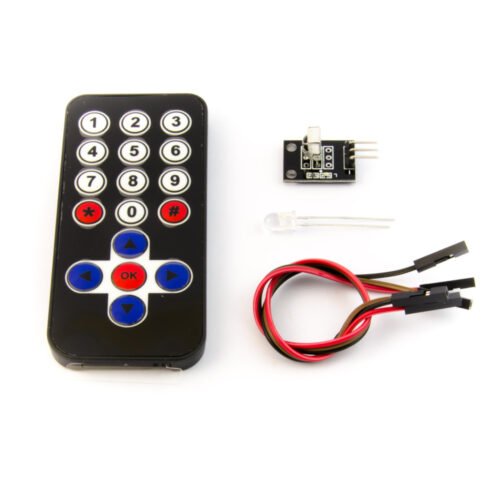
HX1838 Infrared Wireless Remote Control Module
₦ 2,000

Fast Shipping

Technical Support
Nationwide Delivery
To all 36 States
Description
The HX1838 is a 38kHz infrared (IR) wireless remote control module and receiver kit widely used for adding remote functionality to Arduino, Raspberry Pi, and other microcontroller projects. It typically includes an ultra-thin 21-key or 17-key handheld transmitter and a compact receiver module capable of decoding signals up to 8 meters away.
Key Specifications:
The module is designed for low power consumption and high sensitivity in indoor environments.
- Operating Voltage: 2.7V to 5.5V DC, making it compatible with both 3.3V and 5V logic levels.
- Carrier Frequency: 38kHz, which is the standard for most consumer electronics remotes.
- Transmission Distance: Typically 5 to 8 meters (up to 18 meters for the receiver under optimal conditions).
- Effective Angle: 60 degrees.
- Current Consumption: 3–5µA static (idle) and 3–5mA dynamic (active).
- Encoding Format: Uses the NEC protocol for signal transmission.
Receiver Module Features:
The receiver unit is often a breakout board that simplifies wiring with a 3-pin interface.
- Integrated Components: Includes a photodetector, preamplifier, and internal filter for PCM frequency in a single package.
- Pinout:
- VCC: External 3.3V–5V voltage.
- GND: External ground.
- OUT (IN): Digital output to the microcontroller I/O port, often featuring a 10K pull-up resistor.
- Visual Feedback: Many modules include an onboard LED that flashes when an IR signal is successfully received.
Common Applications:
Due to its ease of use and affordability, the HX1838 is a favorite for several DIY and educational projects.
- Home Automation: Controlling lights, fans, or smart appliances with a standard TV remote.
- Robotics: Implementing manual wireless control for robot navigation and task execution.
- Interactive Art: Triggering lights, sounds, or animations in art installations.
- Media Centers: Building custom remote interfaces for PC-based media setups.
Shopping cart
Sign in
No account yet?
Create an AccountHX1838 Infrared Wireless Remote Control Module
₦ 2,000
1
HX1838 Infrared Wireless Remote Control Module is ready to ship 🇳🇬
We are here to help with tech support or orders
Open chat