

Free shipping for orders ₦50,000 and above
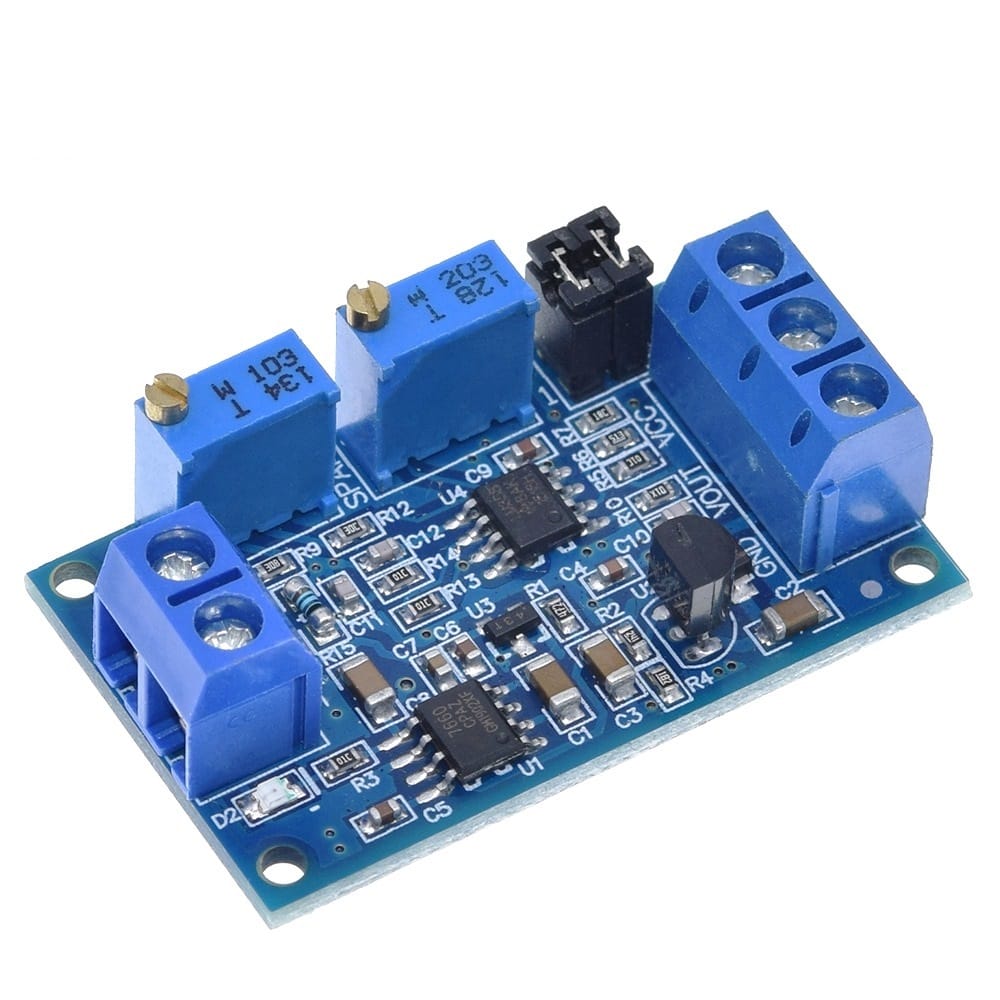
Current To Voltage Module
₦ 3,500

Fast Shipping

Technical Support
Nationwide Delivery
To all 36 States
Description
Current-to-Voltage modules are essential signal-conditioning devices that convert standard industrial current signals (typically 4–20mA) into voltage signals (such as 0–5V or 0–10V) that are compatible with microcontrollers, PLCs, and ADCs. They are primarily used to prevent signal degradation over long distances, as current loops are highly resistant to noise and voltage drops.
Common Module Types:
These modules range from simple hobbyist-friendly PCB boards to rugged, rail-mounted industrial isolators.
- Gravity: Analog Current to Voltage Converter (SEN0262)
- Performance: Employs a 0.1% high-precision sense resistor and ultra-low noise rail-to-rail zero-drift op-amp.
- Specifications: Supports a 0–25mA input range (ideal for fault diagnosis below 4mA) and outputs 0–3V DC. It is powered by 3.3V–5.5V and has a measurement accuracy of ±0.5% at 16-bit ADC.
- Universal Industrial 4-20mA to 0-10V Converter
- Adjustability: Features on-board ZERO and SPAN potentiometers for fine-tuning the minimum and maximum output values.
- Power: Operates on a wide supply voltage of 7V–36V; however, if a 10V output is required, the supply must be at least 12V.
- RS PRO 1923394 Isolated Signal Converter
- Mounting: Designed for standard DIN rail installation in industrial cabinets.
- Protection: Provides three-way isolation between input, output, and power supply to protect against surges. It has an IP20 rating and operates between -25°C and +60°C.
Key Technical Specifications:
Most generic industrial modules share the following performance characteristics:
- Input Ranges: Typically supports 4–20mA (industrial standard) and 0–20mA.
- Output Ranges: Jumper-selectable or fixed outputs of 0–3.3V, 0–5V, or 0–10V.
- Driving Capacity: Usually limited to a maximum of 15mA for the output signal.
- Safety Features: Often includes reverse polarity protection to prevent damage during wiring.
Calibration Steps:
For modules with adjustable potentiometers, follow these general steps:
- Zero Calibration: Set input current to 4mA (or 0mA) and rotate the ZERO potentiometer until the output voltage reaches its minimum (e.g., 0V).
- Span Calibration: Set input current to 20mA and rotate the SPAN potentiometer until the output reaches your target maximum (e.g., 5V or 10V).
Instructions for use:
- Module according to the definition of wiring, power supply voltage 7-36V (if the output to 10V, the supply voltage must be greater than 12V).
- After power-up, the D2 indicator should be on, otherwise check the line connection. Board with reverse protection, reverse does not burn.
- When the current input is the minimum (0mA or 4mA), adjust the ZERO potentiometer so that the VOUT output is the minimum (0.0V or other voltage).
- When the current input is at maximum (20mA), adjust the SPAN potentiometer so that the VOUT output is the maximum (3.3V or 5V or 10V, the output can be as low as 2.5V when the input is 4-20ma).
- According to your needs, through the jumper cap to select the appropriate range
Shopping cart
Sign in
No account yet?
Create an AccountCurrent To Voltage Module
₦ 3,500
1
Current To Voltage Module is ready to ship 🇳🇬
We are here to help with tech support or orders
Open chat