

Free shipping for orders ₦50,000 and above
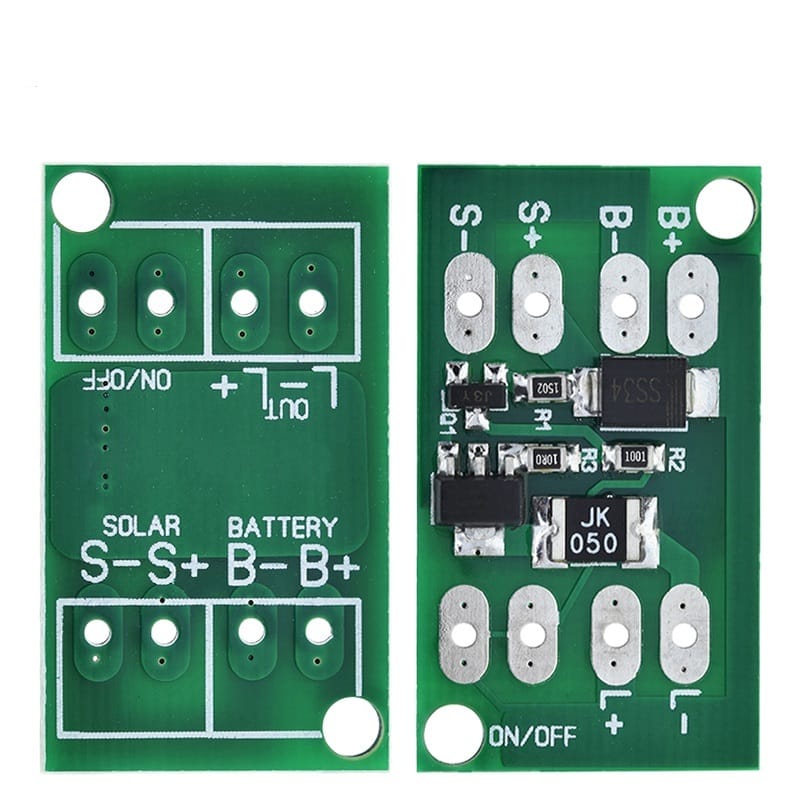
Automatic Solar Panel Battery Charger
₦ 6,500
10 in stock
10 in stock

Fast Shipping

Technical Support
Nationwide Delivery
To all 36 States
Description
Automatic Solar Panel Battery Charger is a specialized, compact control circuit designed to manage charging and discharging for small solar lighting systems automatically. This board intelligently handles the solar panel input, charging the battery during the day, and consequently, it switches the attached LED light load on automatically when darkness is detected.
It is widely recognized as a highly efficient and indispensable component for DIY solar garden lights, landscape illumination, and other low- power, self-contained solar projects. Furthermore, this integrates essential protection circuits, preventing battery overcharge and over-discharge, which significantly extends the overall battery lifespan and system reliability. Therefore, you can easily build robust, maintenance-free solar lighting products using this single, integrated module.
Features:
- Automatic Light Control: Features an integrated photo-sensing circuit (via the solar panel voltage) that automatically turns the LED load ON at dusk and OFF at dawn.
- Battery Protection (BMS): Includes essential safety features to prevent battery overch and deep discharging, maximizing battery.
- Low Voltage Drop: Utilizes a low-loss charging and switching circuit, ensuring maximum power transfer efficiency from the solar panel to the battery and the load.
- High-Current Capability: The board supports maximum charging currents of up to 5 A and maximum load currents of up to 5 A, suitable for moderately sized LED arrays.
- Wide Battery Compatibility: Designed to operate efficiently with standard 3.7 V (1S) Li- ion batteries or 3.2 V (1S) LiFePO4 batteries.
Technical Specifications:
- Supported Battery Voltage: 3.2 V (LiFePO4) or 3.7 V (Li-ion) single cell
- Solar Panel Input Voltage: DC 4.5 V to 6 V
- Maximum Charging Current: 5 A (Continuous)
- Maximum Load (LED) Current: 5 A (Continuous)
- Charging Stop Voltage: 4.2 V (For 3.7 V Li-ion) 3.6 V (For 3.2 V LiFePO4)
- Discharge Stop Voltaggd V (For 3.7 V Li-ion) or 2.8 V (For 3.2 V LiFePO4)
- Control Mode: Light-activated (Turn ON vo solar panel voltage drops below threshold
Mechanical Specifications:
- Board Material: High-quality PCB with clearly marked connection pads.
- Mounting: Designed for embedding within lighting enclosures (no external mounting holes often required).
- Connections: Solder pads for Solar Panel (+/-), Battery (+/-), and LED Load (+/-).
- Component Type: Surface Mount Technology (SMT) for compact size and reliability.
Dimensions:
- Board Length: ≈ 42 mm
- Board Width: ≈ 17 mm
- Board Height (Max): ≈ 5 mm
- Weight: ≈ 3g (Ultra-lightweight)
Pinout and Wiring:
- SP+: Connect the positive (+) output of your solar panel (4.5 V to 6 V).
- SP-: Connect the negative (-) output of y solar panel here (Ground).
- BATT+: Connect the positive (+) terminal of the 3.7 V or 3.2 V rechargeable battery.
- BATT-: Connect the negative (-) terminal of the battery.
- LED+: Connect the positive (+) lead of the LED lamp or LED array.
- LED-: Connect the negative (-) lead of the LED lamp.
Wiring Note:
Ensure all connections follow the correct polarity, otherwise, you risk damaging the control board and the connected components. The LED load must match the battery voltage (e.g., use a 3.7 V LED string with a 3.7 V battery).
Commonly Used in:
- DIY Solar Garden Lights: Providing the complete control logic for standard landscape lighting fixtures.
- Solar Pathway Markers: Integrating essential charging and light-sensing features into ground-level markers.
- Small Portable Solar Systems: Powering low-current devices that require autonomous operation based on ambient light.
Applications:
- Off-Grid Illumination: Automatically powering security lights, fence lights, and advertising sign illumination.
- Emergency Lighting: Maintaining battery charge and activating a light source upon power failure (using the light-sensing as the trigger).
- Educational Projects: A fundamental component for teaching solar energy management and battery protection circuits.
Shopping cart
Sign in
No account yet?
Create an AccountAutomatic Solar Panel Battery Charger
1
Automatic Solar Panel Battery Charger is ready to ship 🇳🇬
We are here to help with tech support or orders
Open chat