

Free shipping for orders ₦50,000 and above
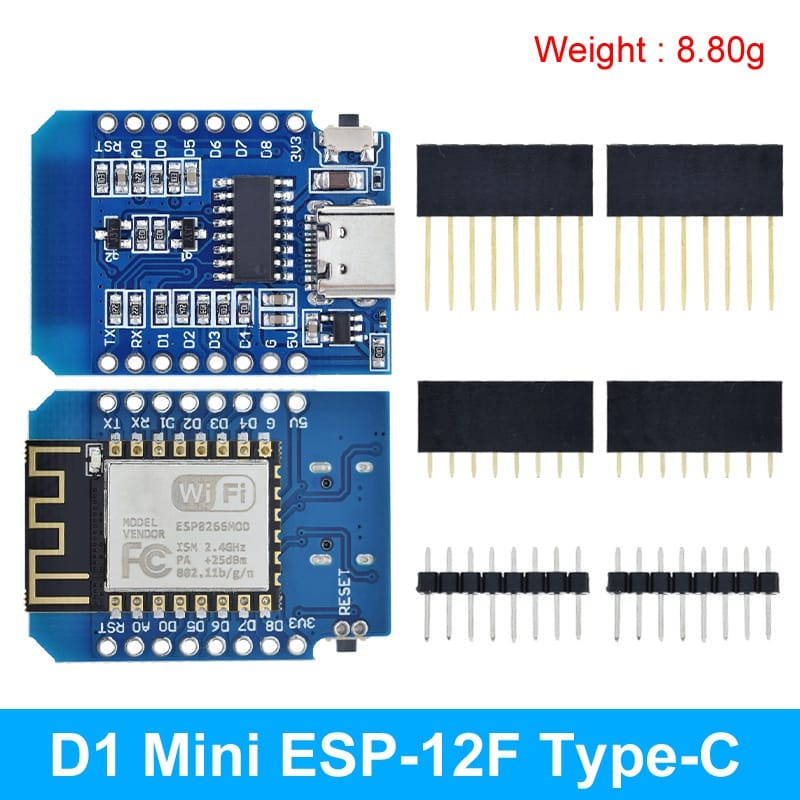
WeMos D1 Mini Type-C
₦ 6,500

Fast Shipping

Technical Support
Nationwide Delivery
To all 36 States
Description
The WeMos D1 Mini Type-C (specifically the V4.0.0) is an updated version of the popular ESP8266-based development board, replacing the older micro-USB port with a more durable and reversible USB-C connector. It remains a compact, WiFi-enabled platform ideal for IoT projects and is fully compatible with the existing ecosystem of D1 Mini shields.
Technical Specifications:
- Microcontroller: ESP8266EX 32-bit processor with a clock speed of 80MHz or 160MHz.
- Memory: 4MB (32M bit) onboard Flash memory.
- Operating Voltage: 3.3V logic level (regulated internally from the 5V USB-C input).
- I/O Pins: 11 digital I/O pins supporting PWM, I2C, SPI, and UART (except D0), and 1 analog input with a 3.2V maximum.
- Dimensions: Ultra-compact footprint of approximately 34.2mm x 25.6mm.
- USB Interface: USB Type-C port using the CH340G USB-to-serial converter.
Key Features:
- Enhanced Connectivity: The V4.0.0 model includes a dedicated I2C port (JST-SH 4-pin) for easier connection to sensors without soldering.
- Software Support: Fully compatible with the Arduino IDE, MicroPython, NodeMCU, and Lua.
- Shield Ecosystem: Designed to work seamlessly with the original stackable shields, including relays, OLED displays, and various sensor modules.
Applications:
- Internet of Things (IoT) projects
- Home automation systems
- Wireless data logging
- Remote sensor monitoring
- Smart home devices
- Educational projects in electronics and programming
Usage:
- Connect the WeMos D1 WiFi UNO to your computer via the USB interface.
- Install the necessary drivers and Arduino IDE with the ESP8266 board support package.
- Write and upload your code using the Arduino IDE, leveraging the WiFi capabilities to connect to networks or web services.
- Use the digital I/O pins, analog input, and onboard LED in your projects according to your needs.
- Monitor and debug your project using serial output or other communication methods.
Caution:
- Ensure proper USB connection and avoid overvoltage to prevent damage.
- Follow the WiFi module’s usage guidelines for optimal performance and connectivity.
- Handle with care to avoid damage to the onboard components.
Shopping cart
Sign in
No account yet?
Create an AccountWeMos D1 Mini Type-C
₦ 6,500
1
WeMos D1 Mini Type-C is ready to ship 🇳🇬
We are here to help with tech support or orders
Open chat